A Theogony of Numbers
Nov. 30th, 2023 06:14 pm![[personal profile]](https://www.dreamwidth.org/img/silk/identity/user.png) randomactsofkarmasc
randomactsofkarmasc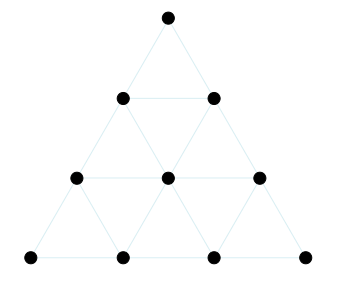
Though there are some similarities, the process of Creation described by Iamblichus is not the same as the process of Creation described by Lubicz. Similarly, the process of Creation I describe below borrows from both Iamblichus and Lubicz, but differs from both as well.
The first dot represents the Monad, which contains everything potentially. All numbers come from the Monad, but the Monad is not considered a number. In isopsephy (assigning numbers to letters, then adding up the numbers of a word) (like gematria, but for Greek instead of Hebrew), the “Rule of Colel” is that one can be added or subtracted to the value of a word without affecting its value, since it really isn’t a number.
The Greeks considered odd numbers to be male and even numbers to be female. The Monad was considered even-odd. It had a dual nature, both the potential to be even and the potential to be odd. Observing this dual nature provokes scission; the Monad creates the Dyad.
| becomes | |. (The easiest metaphor for my understanding is to consider the Monad a bar magnet. It is one magnet with two natures: a positive pole and a negative pole.)
Written another way,
|
| |
This scission of the Monad to the Dyad can also be represented as
A
C B
A is a unity. B is a unity. C is a unity.
Three unities. A Trinity.
But BC is also a unity.
Four unities. A Tetrad.
But wait!
ABC is another unity, so five unities. A Pentad. (Iamblichus and Lubicz explain how to get to the Decad, but getting to the Pentad is far enough for this essay.)
Another way of describing the process of the Monad to the Pentad is
· 1 created 1,
|
|
· which made 2,
| |
· totaling 3,
| |
- Ain Soph creates Ain Soph Aur (so 1 creates 1).
- Ain Soph, as the Cosmic Egg, is split into Ouranos and Gaia (so 1 makes 2).
- Ouranos and Gaia make Kronos (so Kronos would have a value of 2, which doesn’t match with the traditional value of 3, but it is even, which does align with Kronos (and Binah) being on the left side of the Cabalistic Tree of Life and with Kronos reputation of consuming his children).
But after that, things aren’t so neat and tidy.
If Kronos is 2 and Rhea is 1, Zeus would be 3. Zeus being 3 would work, if Hera was 2. (Actually, it would work exceptionally well. Iamblichus considered the Pentad a representation of marriage, since it is formed of the first even (2) and the first odd (3). And Zeus and Hera’s marriage was celebrated as the Hieros Gamos, the Sacred Marriage. And William Stirling (in The Canon) mentioned that Hera was the feminine part of the androgynous Zeus. So androgynous Zeus would have a value of 5 and Lubicz said that the number 5 is the creator. But why would Hera have a value of 2?)
So let’s try a different triangle. We start with 1, with a dual nature, so scission creates 1 1.
1
1 1
1 and 1 create 2, so we have
1
1 1
2
The uppermost 1 is Kether. The 1 on the right is Chokmah, the “force” emanating from Kether. The 1 on the left is Binah, the Great Sea that receives the force (giving it form). When 2 is created, Kether continues to emanate, so we have
1
1 1
1 2 1
Two, according to Lubicz, is androgynous, containing a potential active nature (force) and a potential passive nature (form). Two can procreate with either force or form, making 3.
1
1 1
1 2 1
1 3 3 1
Since the active nature and the passive nature of Two procreated to make Three, they are no longer potential, but actual. (So Three isn’t androgynous, it is bisexual.)
The next iteration is
1
1 1
1 2 1
1 3 3 1
1 4 6 4 1
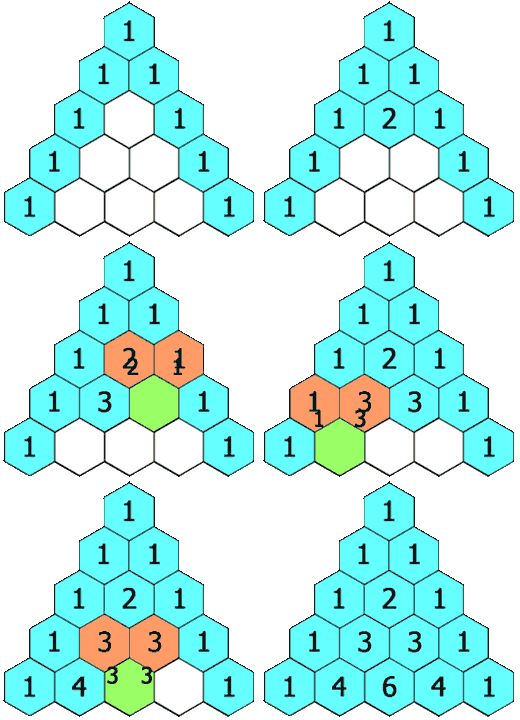
This pattern (known as Pascal’s Triangle, first described by Al-Karaji and later by Omar Khayyam) is based on a binomial (a + b) raised to a power x.
The first row is (a + b)0 = 1.
The second row is (a + b)1 = 1a + 1b. Using a = 1 and b = 1 (since 1 is our creative unity), we get 1 and 1.
The third row is (a + b)2 = 1a2 + 2ab + 1b2. Again, using a = 1 and b = 1, we get 1 2 1.
The fourth row is (a + b)3 = 1a2 + 3a2b + 3ab2 + 1b3, or 1 3 3 1.
From Lubicz, “As number (quality), 1 is abstract and becomes concrete only when it is 10, and 10 is 1 made concrete: 10 is the first power of 1!” (So if you consider Creation as taking four Trees (one for Atziluth, one for Briah, one for Yetzirah, and one for Assiah) then the second row of Pascal’s Triangle would represent Atziluth (the binomial to the first power, so Kether to Malkuth one time). The second row is the binomial to the second power, so another iteration of Kether to Malkuth.
Let’s try the theogony again…
(a + b)0 is Ain Soph and Ain Soph Aur
(a + b)1 is Ouranos and Gaia
(a + b)2 is Kronos and Rhea. Two is androgynous, so it procreates with the One on the left and the One on the Right.
(a + b)3 is Zeus. There are two Threes, which is fitting, since Three is bisexual. Zeus is masculine with Hera (producing Ares, et al) and with Demeter (producing Persephone). But Zeus is, at times, feminine (producing Athena and Dionysus). (And, in this triangle, the Threes produce the Six, which is Apollo!)
And then there is the Fibonacci sequence, the golden ratio of Creation alluded to earlier (1, 1, 2, 3, 5). I tried to make that work; I wanted to make that work. I could not make it work. And then I found Pascal’s Triangle, and that seems to work quite well. And then I found that the Fibonacci sequence is in Pascal’s Triangle!
Instead of
1
1 1
1 2 1
1 3 3 1
1 4 6 4 1
make the numbers left aligned
1
1 1
1 2 1
1 3 3 1
1 4 6 4 1
and then add the numbers on the diagonal.

https://en.wikipedia.org/wiki/File:Fibonacci_in_Pascal_triangle.png
It seems important that the line going through 6 (Apollo) is 13 (Death/Transformation). And it also seems important that the line going through the first 10 is 21 (a cycle of the Tarot Trumps, perhaps?). But those are meditations for another day.


